
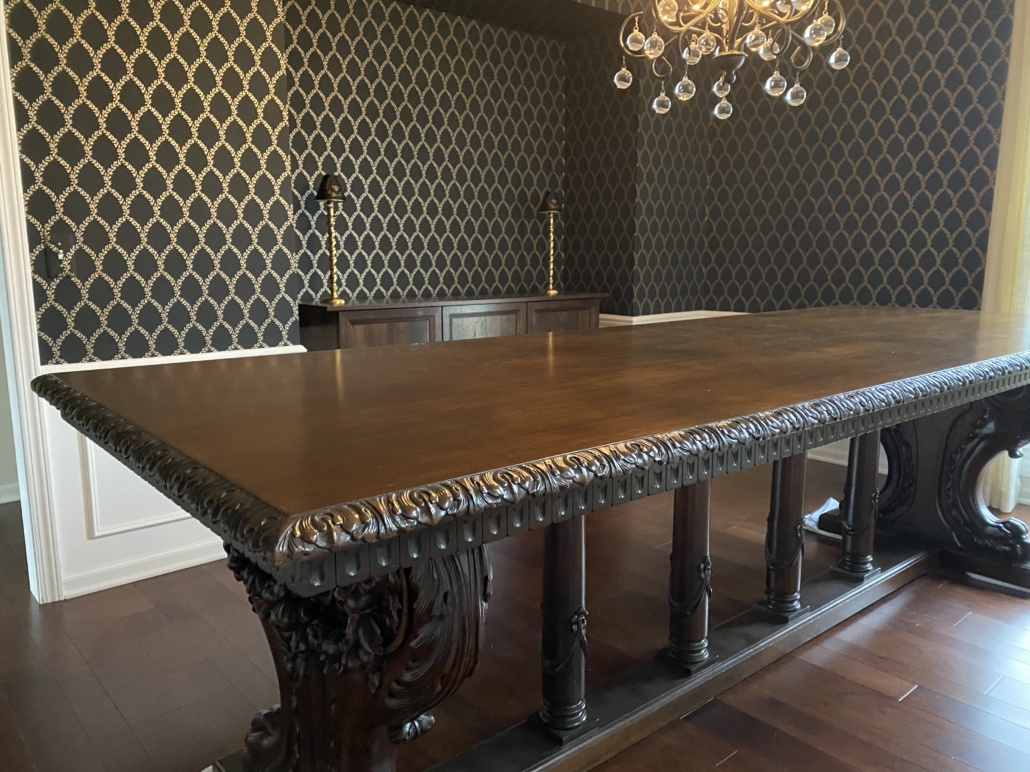
The Table Henry Ford Slept On
By Barry Bernau
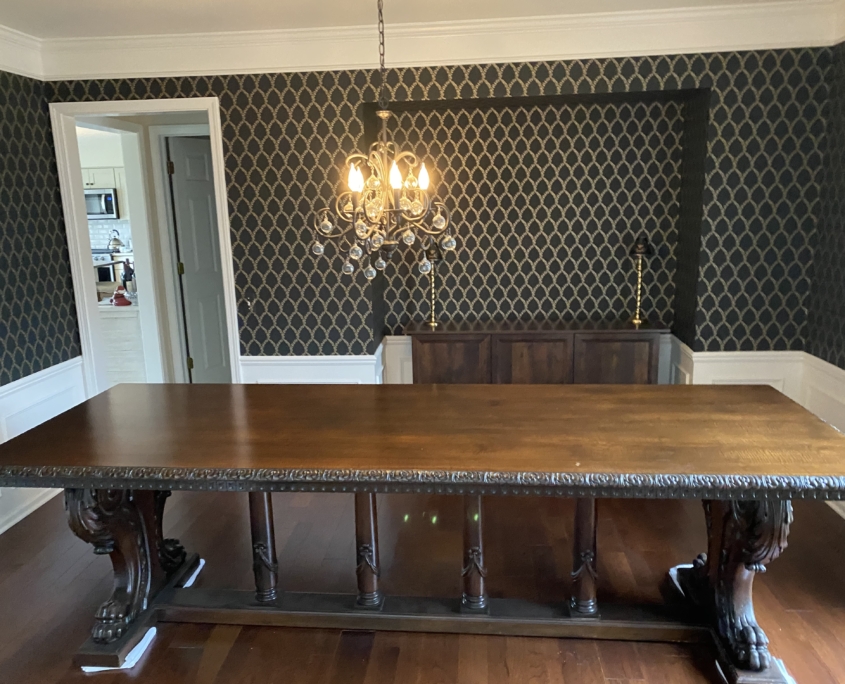
The table a homeowner said Henry Ford slept on at the Highland Park plant, surrounded by black and gold laurel leaf wallpaper installed by Barry Bernau.
When I was six years old, I had to play Henry Ford in a school play. My parents put a cardboard box cutout of a Model T around me and sent me out on stage. I was born at Henry Ford Hospital in Detroit, so maybe it was meant to be.
Years later, back in the late ’80s, my brother told me about a book. Ford: The Men and the Machine by Robert Lacey. It was a very thick book. Now, at that point in my life, I had maybe read three books all the way through. But this one got me. I found a torn old copy in a secondhand resale shop, took it home, I couldn’t put it down.
What grabbed me wasn’t just Ford the titan. It was Ford the eccentric. The tinkerer. The kid in him.
That’s how I read the book. Like a kid reading about another kid. He would take watches, take them apart, put them back together, and do it over and over. That little tinkerer seemed to follow him throughout his whole life — the same way mine follows me. Excited about little things. Building things. Making it right. It’s not about the money. It’s about making something better. Something exciting. Something that matters.
Later in life, he took that same concept he learned from the Swiss watchmakers — the assembly line — and implemented it into automobile manufacturing. And forever changed the world as we know it.
I mean, he built the Quadricycle in his shed and fired up that small combustion engine in his kitchen sink. Can you imagine how he felt? How exciting that must have been? His wife had to put up with all of it. God bless her. But in that moment, there’s no thinking about money. It’s just the thing he’s doing and it’s exciting!
So here I am, how many years later, a big fan of Henry Ford, and I get called to hang wallpaper in a dining room.
I walk in and there’s this huge table. It takes up the room. Massive. Dark wood. Heavily carved legs ending in lion’s paw feet. Ornate edges. Turned columns along the base. The surface worn smooth from a century of hands.
The homeowner tells me it’s Henry Ford’s desk — the one he slept on at the Highland Park plant. It had been in her family a long time. Her family had owned one of the earliest Ford-affiliated dealerships in Michigan, right on Woodward Avenue, connected to the Highland Park factory itself — the same building where the moving assembly line was born.
I set down my tools on the drop cloths without stopping my gaze. I just looked at it. Walked around it. Amazed. This wasn’t just a table. This is history.
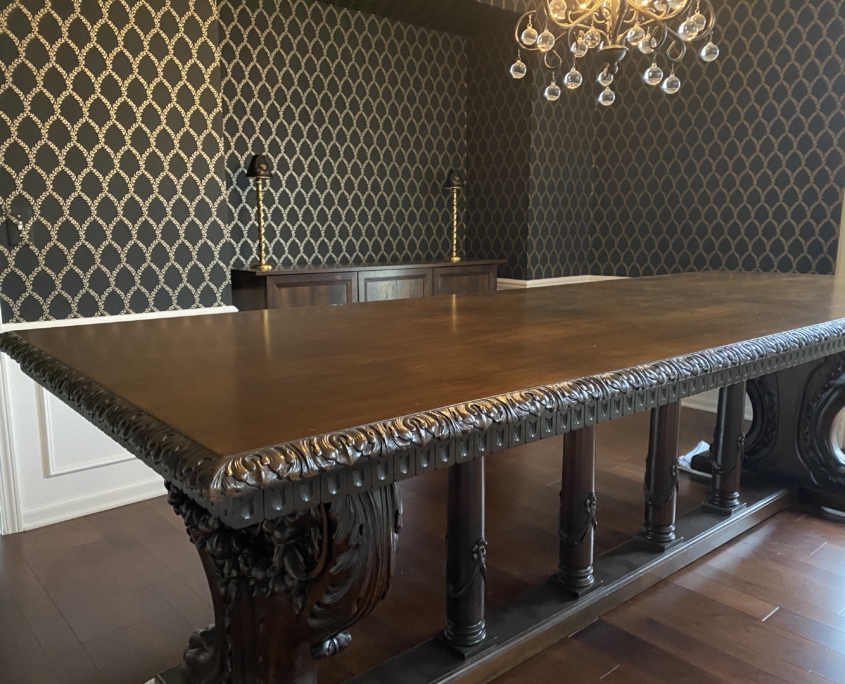
Could Henry Ford be lying there now with his hands behind his head, looking up, seeing me do the work?
What a treat to do this work. But not only to do it — to do it right.
The wallpaper was black. Beautiful pattern — dark charcoal with gold laurel leaves in a trellis. How fitting. Henry Ford once said you can have the Model T in any color you want, as long as it’s black. Well, the wallpaper was black too. But like most wallpaper, the backing underneath is white. On a paper this dark, every seam has the potential to show a thin white line where the edges meet.
So I took each sheet and very carefully ran a black alcohol marker along the edge. Just the edge — not the face, not the top. Just enough to kill that white line. And on the underside of it too. Why alcohol markers? Because the wallpaper paste is water-based. If I used a water-based marker, it would run and bleed and stain the paper. The alcohol ink stays put.
Perfect seams.
Then there was the vent.
I took the HVAC vent cover home with me. I scuffed it up with an emory board, wiped it down, and sprayed it with black satin paint. Three coats. Completely covered, front and back. Brought it back the next day. Used the best adhesives for wallpaper, matched up the pattern perfectly, and wrapped that vent with detailed cutting — as you can see in the pictures. Why go through all that? Because if I didn’t paint it black first, you’d see white peeking through the slats of the vent. And that’s not acceptable. Not on this job. Not on any job.
Every corner matched perfectly. Everything was level — checked with a laser level. The outlet plates were cut clean and tight. No tears. No rough edges. No shortcuts.
The walls had been primed black to match the paper so nothing would bleed through underneath. Every detail, from the primer to the paint on the vent to the marker on every seam edge, was there for a reason.
The whole time I was working, I kept wondering — could Henry Ford be lying there now with his hands behind his head, looking up, seeing me do the work? Would he be impressed? I did my best.
When I finished, I was talking with the homeowner about the book. How it changed the way I saw things. How Ford was an inspiration to me. How he was a tinkerer before he was a titan. How reading about a man who took apart watches as a kid somehow made me better at what I do. Made me try harder.
She’d never heard of it. That afternoon, she went on Amazon and bought a copy for her husband as a Christmas gift.
I thanked her for the work and said what a pleasure it was to install the wallpaper in her dining room.
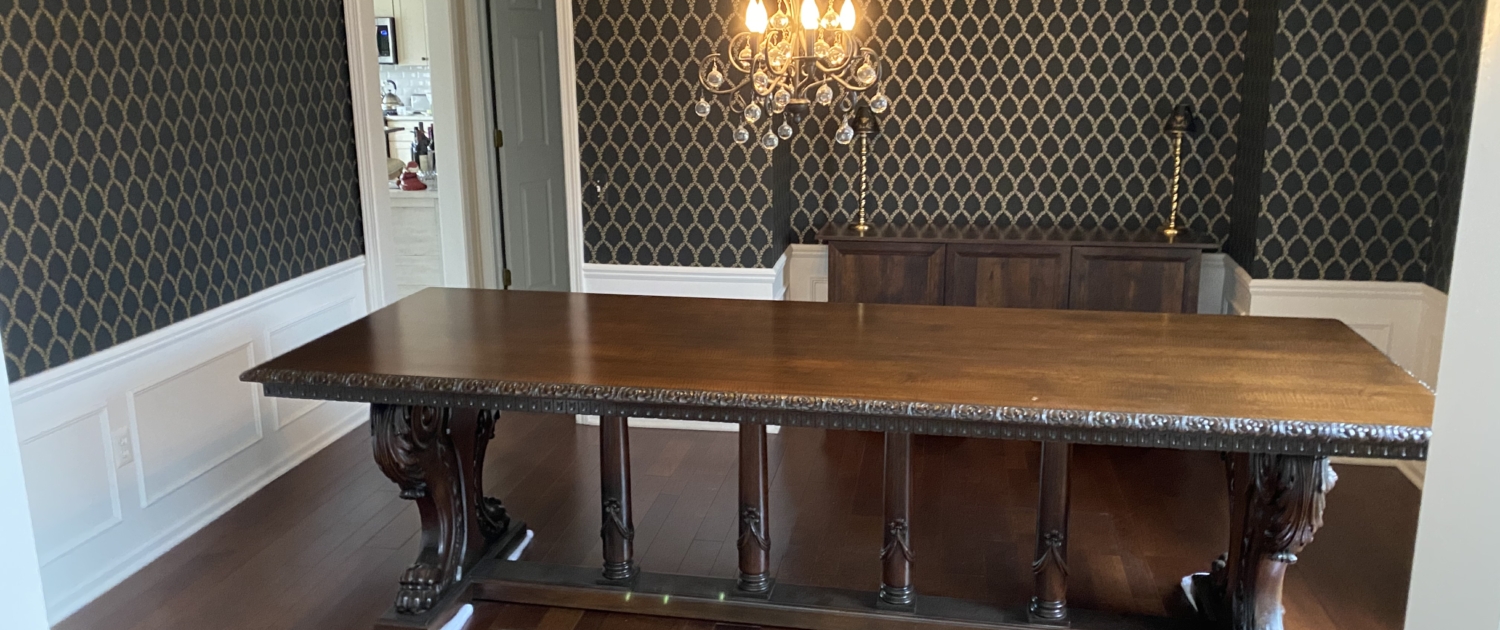
The table stayed in the middle of the room. The walls around it were right. As I walked out, I took one last look at the table and said thank you.
:
As I walked out, I took one last look at the table and said thank you.
Barry Bernau is the owner of Bernau Designs, based in Troy, Michigan. He has been installing wallpaper since 1990 and is also the inventor of the Liscia® wallpaper smoothing tool and focalScan, his LiDAR-based room scanning and estimating app featured in The UK Telegraph’s “30 Best Property Apps.” For estimates, visit 54inch.com or call (248) 924-8944.
