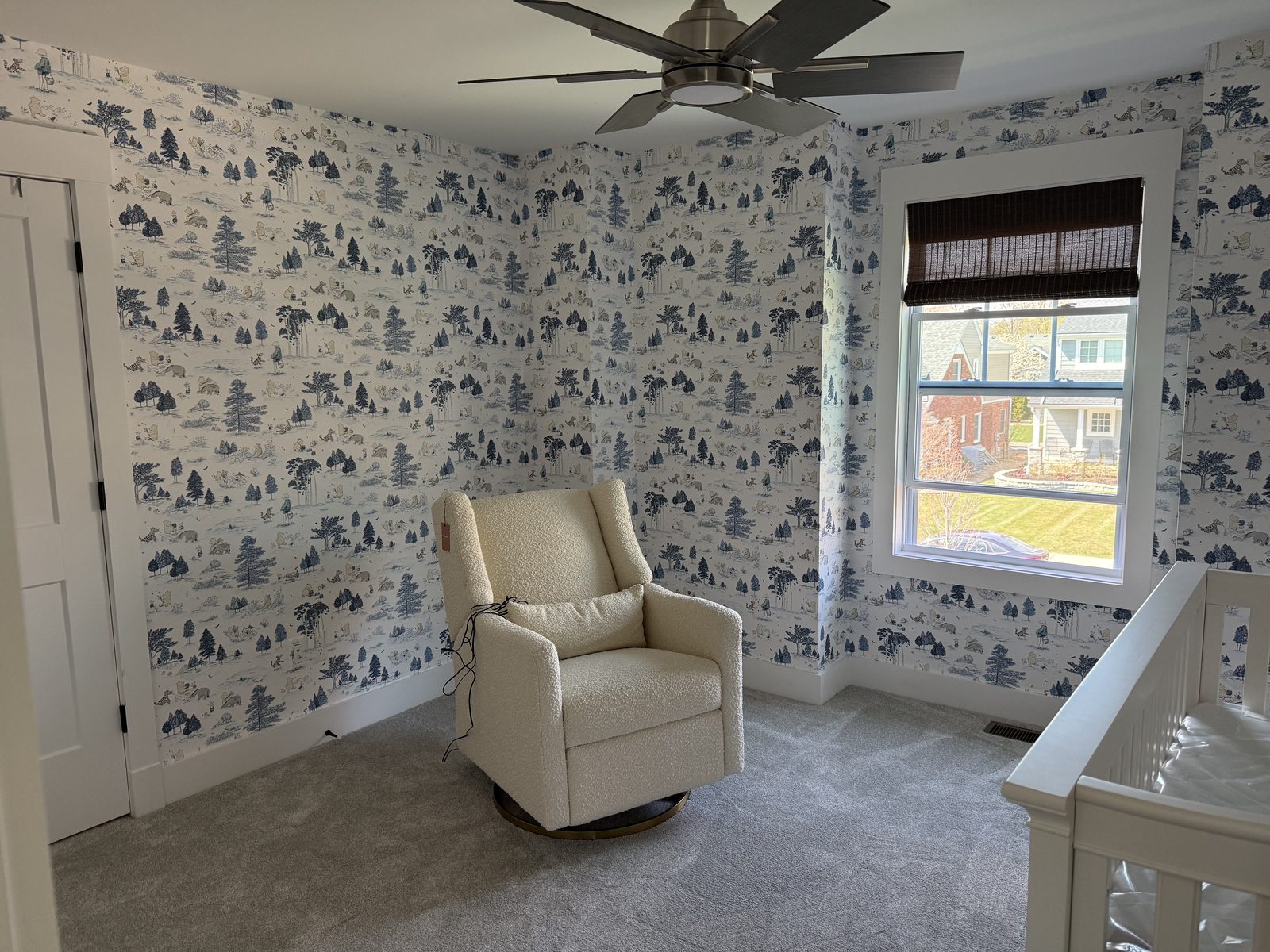
There are rooms made for children, and there are rooms which seem to remember what being a child was like.
This one became the second sort.
Winnie the Pooh has been wandering about the Hundred Acre Wood for nearly a hundred years now, which is quite a long time to spend looking for honey, even by Pooh's standards. Children who once knew him grew up and had children of their own, and those children grew up too.
So Pooh has managed something rather difficult.
He has stayed little while everybody else got older.
That is part of what makes him so right for a nursery.
When I first looked across this room in Plymouth, Michigan, the wallpaper didn't immediately announce itself as Disney. From the doorway there were simply trees and hills and little blue scenes wandering quietly across a warm cream background. It had the feeling of an old illustrated storybook, or perhaps a toile that had become slightly distracted and allowed a bear, a tiger and a donkey to wander into it.
Only when you came closer did you begin finding them.
Pooh with his honey pots.
Tigger among the trees.
Eeyore looking very much like Eeyore.
Christopher Robin.
And suddenly the wall wasn't simply decorated anymore.
It had become somewhere.
A Hundred Acre Wood that doesn't shout
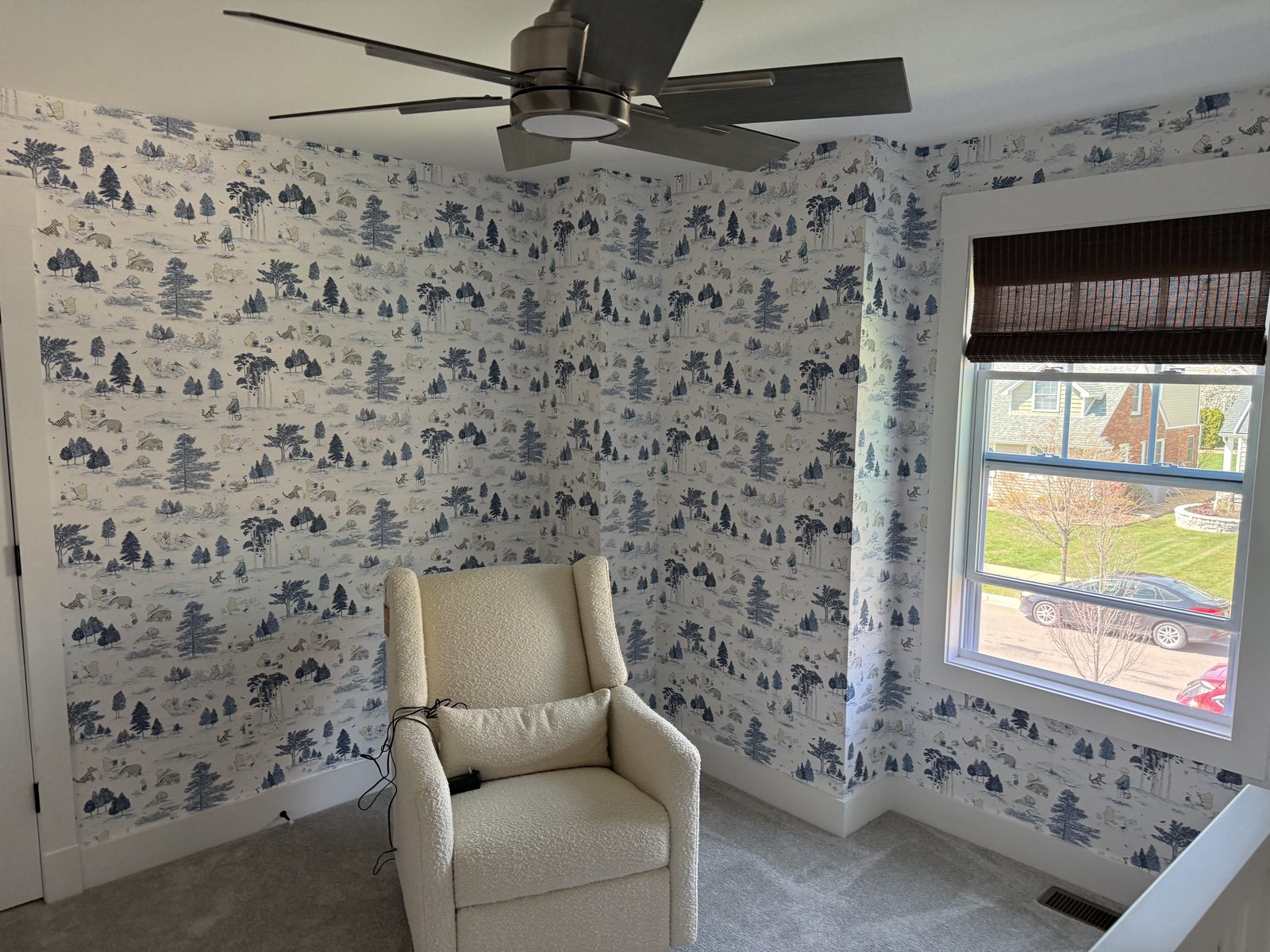
One of the nicest things about Sanderson's Winnie the Pooh wallpaper is that it doesn't try terribly hard to remind you that it is Winnie the Pooh wallpaper.
From across the room, you see the landscape first.
The dark Bonbon Blue trees give the walls structure, while the smaller drawings sit quietly between them. The characters are there, certainly, but they wait for you to find them.
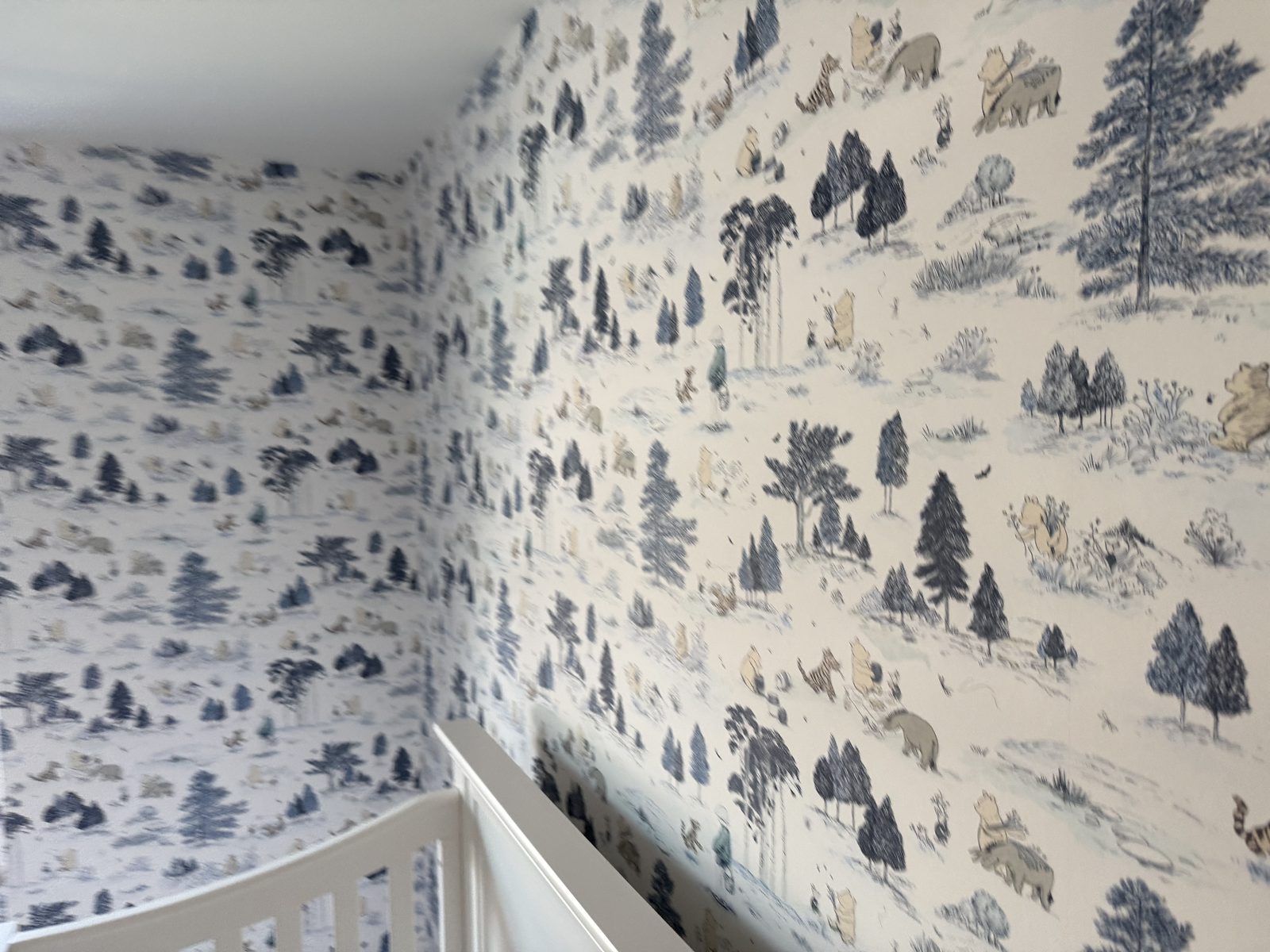
That matters in a nursery.
There is a considerable difference between decorating a room for a baby and decorating a room which can only ever belong to a baby.
This paper feels playful without feeling temporary. A child can discover the characters. An adult can appreciate the drawing. And from a distance the whole thing settles into the room almost like a traditional English toile.
Sanderson calls the colorway Bonbon Blue, part of the Disney Home × Sanderson collection. It is sold through Sanderson and retailers including Pottery Barn Kids.
The wallpaper comes on a 27-inch-wide roll a little over 33 feet long, with a roughly 22-inch repeat and a half-drop match. It is a non-woven, paste-the-wall wallcovering.
Which is a very sensible collection of words on a specification sheet.
The wall, however, has never read a specification sheet.
Pretty wallpaper still has to behave like wallpaper
A half-drop pattern doesn't repeat directly beside itself.
The next strip moves by half the pattern repeat. The strip after that comes back into alignment with the first.
So Pooh and Tigger don't march politely across the wall in a straight row, which is probably just as well. They move up and down as the installation progresses, along with trees, hills, honey pots and everything else Sanderson has scattered through the design.
And this is where hanging wallpaper becomes something more than simply putting one strip beside another.
It becomes layout.
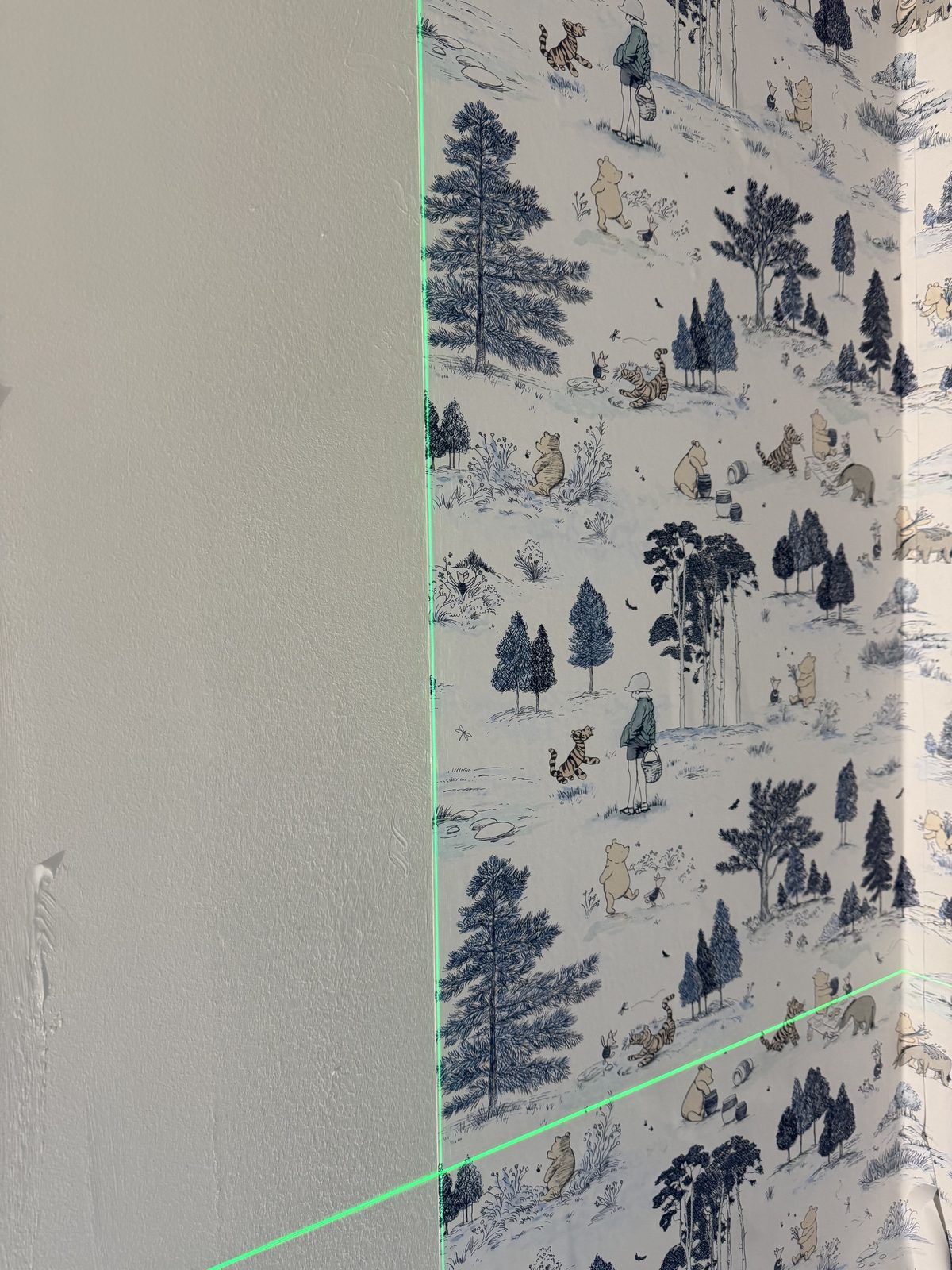
Before any paper went up, I put up a cross-line laser.
A wall may appear perfectly straight and still have its own opinion on the matter.
The laser does not.
It gives me a true vertical and horizontal reference so I know where the paper actually is rather than where the ceiling, corner or trim would like me to believe it is.
Then comes the part that takes place mostly in your head.
Where should the pattern begin?
What will happen when it reaches the window?
Where will Pooh land beside the door?
What happens to a large tree when the pattern turns the corner?
And, perhaps most importantly, can we avoid leaving half of somebody's head beside a piece of trim for the next twenty years?
Those decisions are made before the first strip reaches the wall.
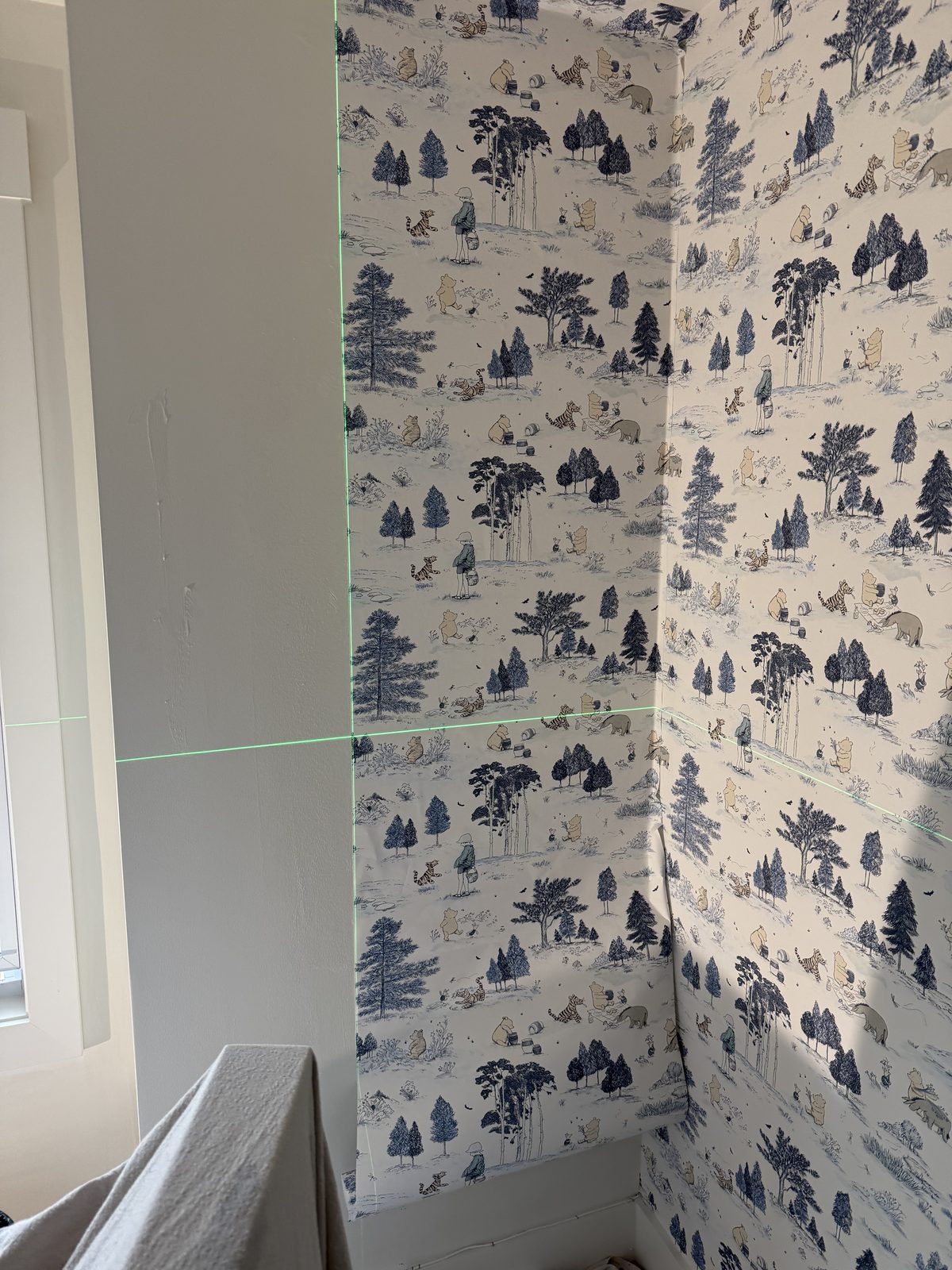
Corners are particularly good at exposing bad decisions.
The pattern has to leave one wall and continue onto the next while the wall itself changes direction underneath it. The laser keeps the new strip vertical while the pattern tells me where it wants to meet the strip I've just finished.
When everything is right, nobody notices any of this.
They simply see the forest continuing around the room.
Which is exactly what should happen.
Before Pooh arrived
Wallpaper gets all the attention.
Walls do most of the work.
Before the Sanderson paper went up, the walls were prepared with Zinsser Shieldz Clear Acrylic Wall Size. It seals and sizes the surface and gives the adhesive a uniform wall to work against.
It also gives me better control while positioning the wallpaper.
This is not the glamorous part of the story.
There are no bears.
There is no Hundred Acre Wood.
There is simply a properly prepared wall waiting patiently for something better to happen to it.
Nobody notices the primer when the room is finished. That's sort of the point.
The Winnie the Pooh wallpaper was installed with Roman PRO-880 Ultra Clear adhesive.
PRO-880 gives me something particularly valuable on a half-drop pattern: working time.
A strip goes onto the wall. It moves slightly. The match is brought together. The strip is checked against the laser. It may move again.
And sometimes a fraction of an inch is the difference between a pattern that looks as though it simply happened there and one which reminds you that somebody installed it.
The best wallpaper installations generally belong to the first category.
Because walls contain inconvenient things
There is a slight difficulty with covering a room in a forest.
Real rooms contain electrical outlets.
And light switches.
And windows.
And doors.
And return-air vents.
The Hundred Acre Wood, as far as I know, had very few of these.
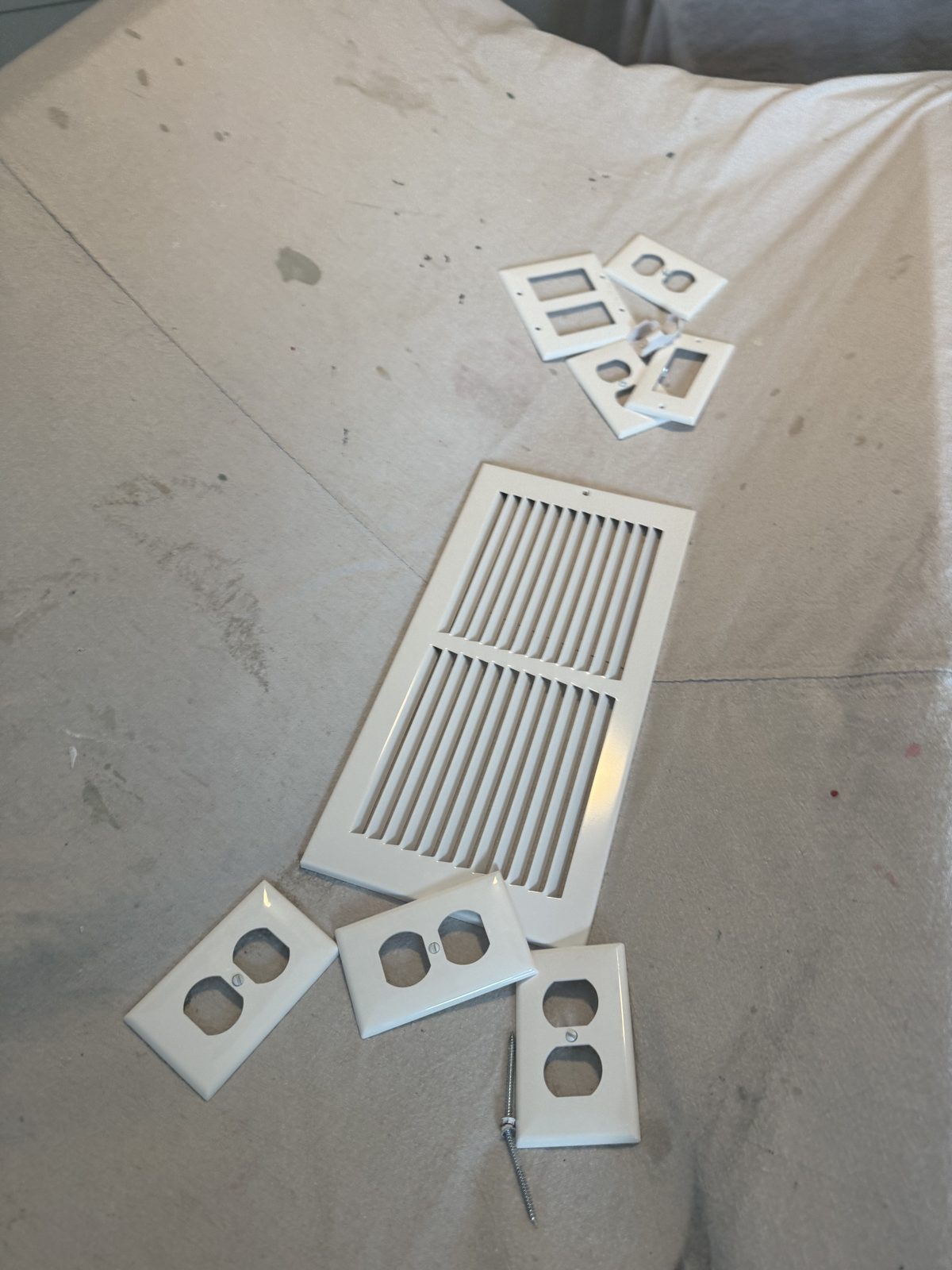
Before the wallpaper went up, outlet plates and the return-air grille were removed.
Trying to wallpaper neatly around hardware that should have been removed is rather like trying to put someone's shirt on without asking them to take their coat off first.
It can probably be done.
But there is no particularly good reason to do it that way.
The return-air vent received a little more attention.
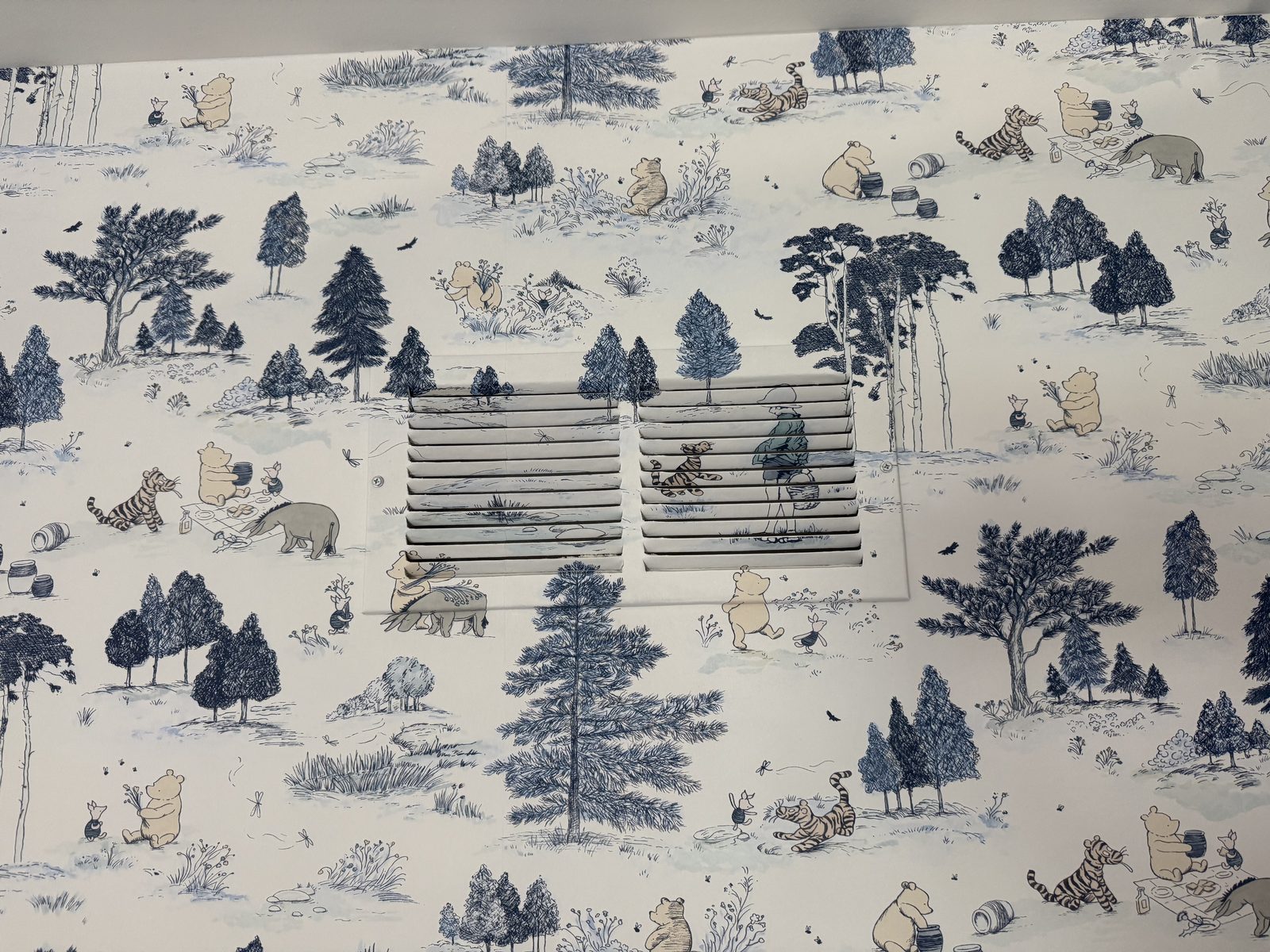
A white metal grille sitting in the middle of all those blue trees would have immediately become the most noticeable object on the wall. So I covered the vent in the same wallpaper and matched its pattern to the wall behind it.
The trees continue across it.
The little figures continue across it.
And the vent does its very best to stop being a vent.
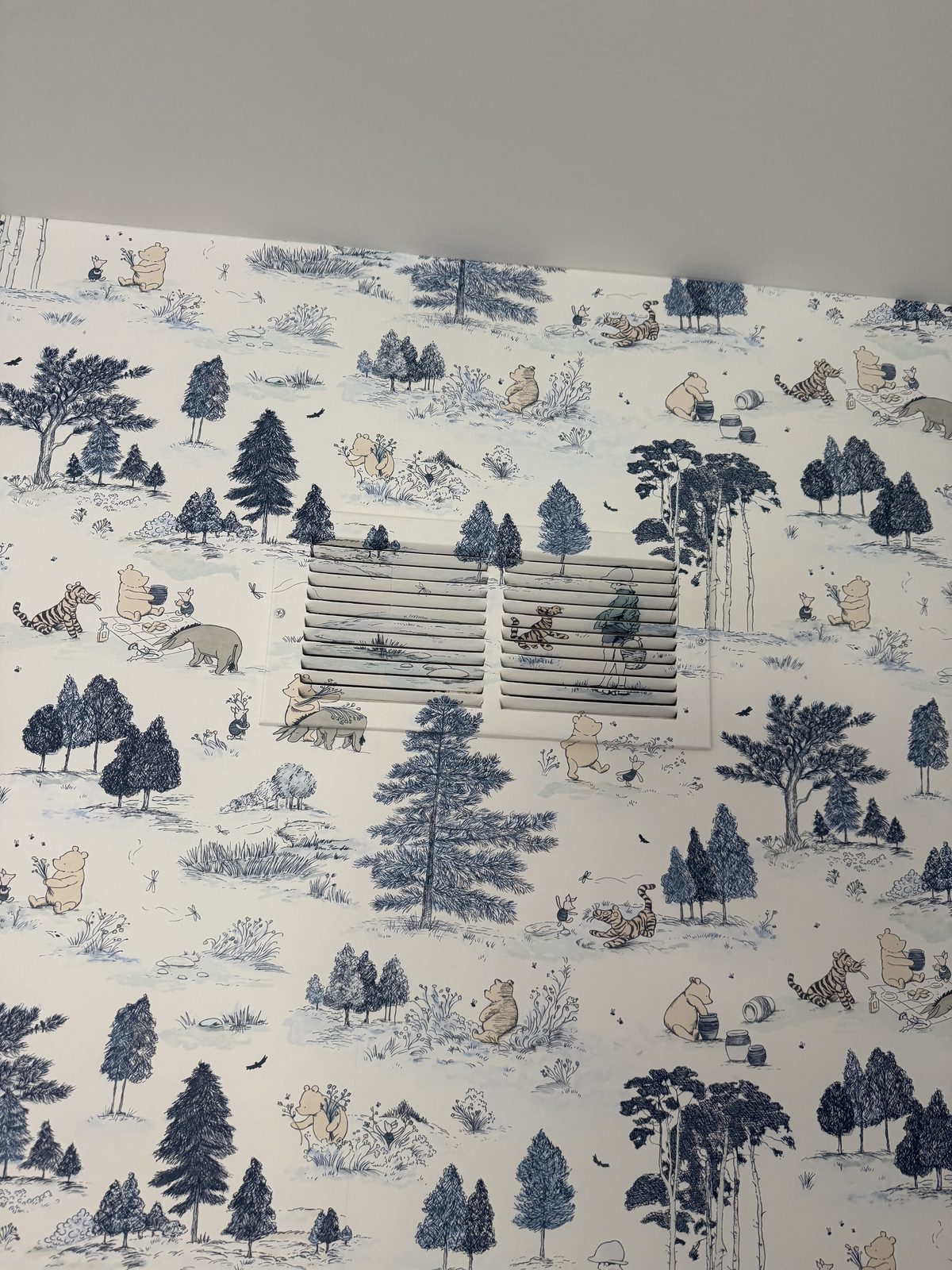
I rather like details like this.
Not because somebody walks into a nursery and says, "What a beautifully wallpapered return-air grille."
Hopefully they don't mention it at all.
Their eye simply keeps moving across the wall.
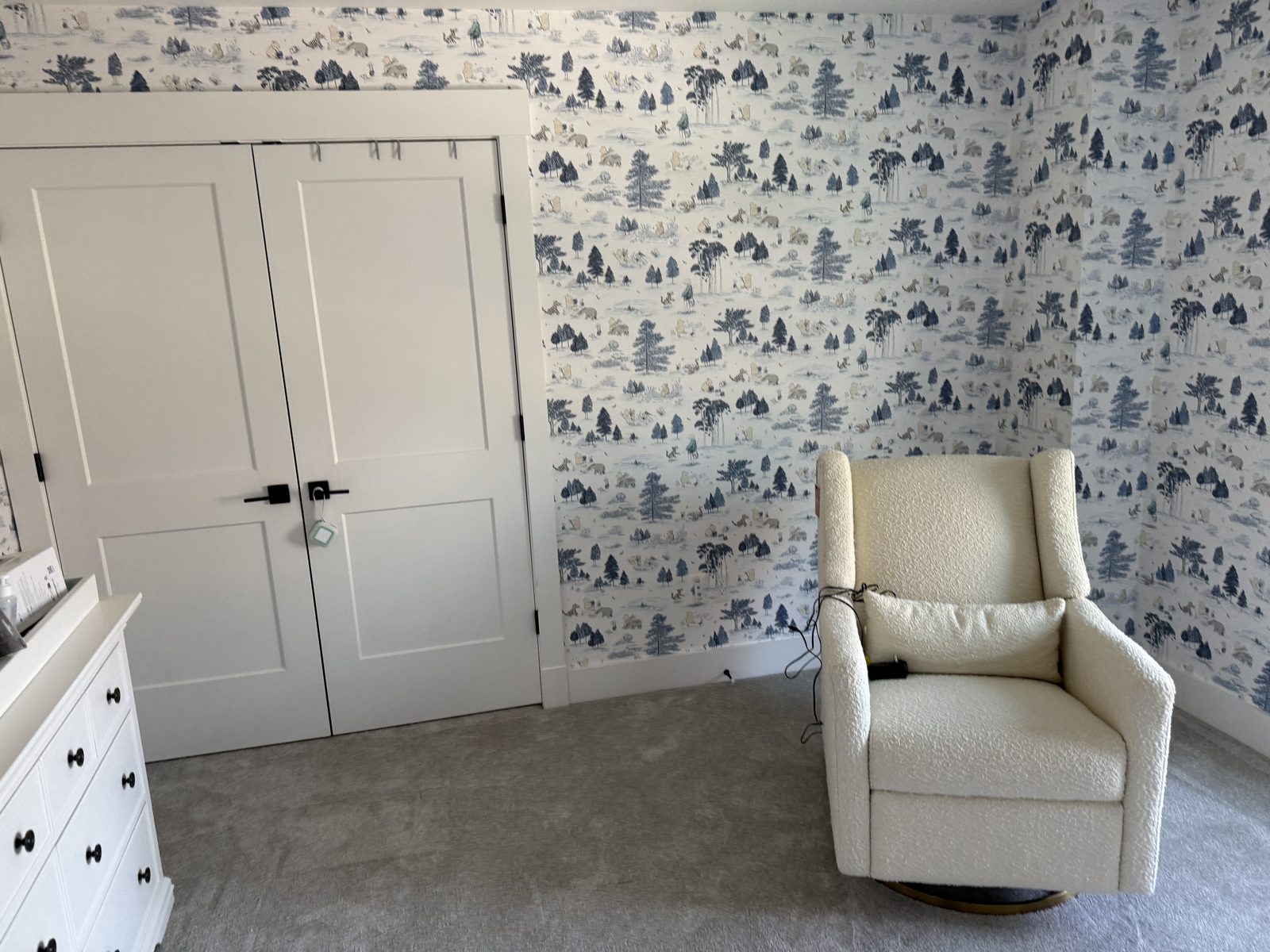
The same idea applies everywhere the wallpaper meets the architecture.
Window casing.
Door casing.
Closet trim.
Corners.
Each one interrupts the printed landscape, so each one requires a decision about where the pattern stops and where it begins again.
By the time those decisions become visible, most of them were made several strips earlier.
Wallpaper is funny that way.
The thing you're doing now is often determined by something you decided twenty feet ago.
And then it became a nursery
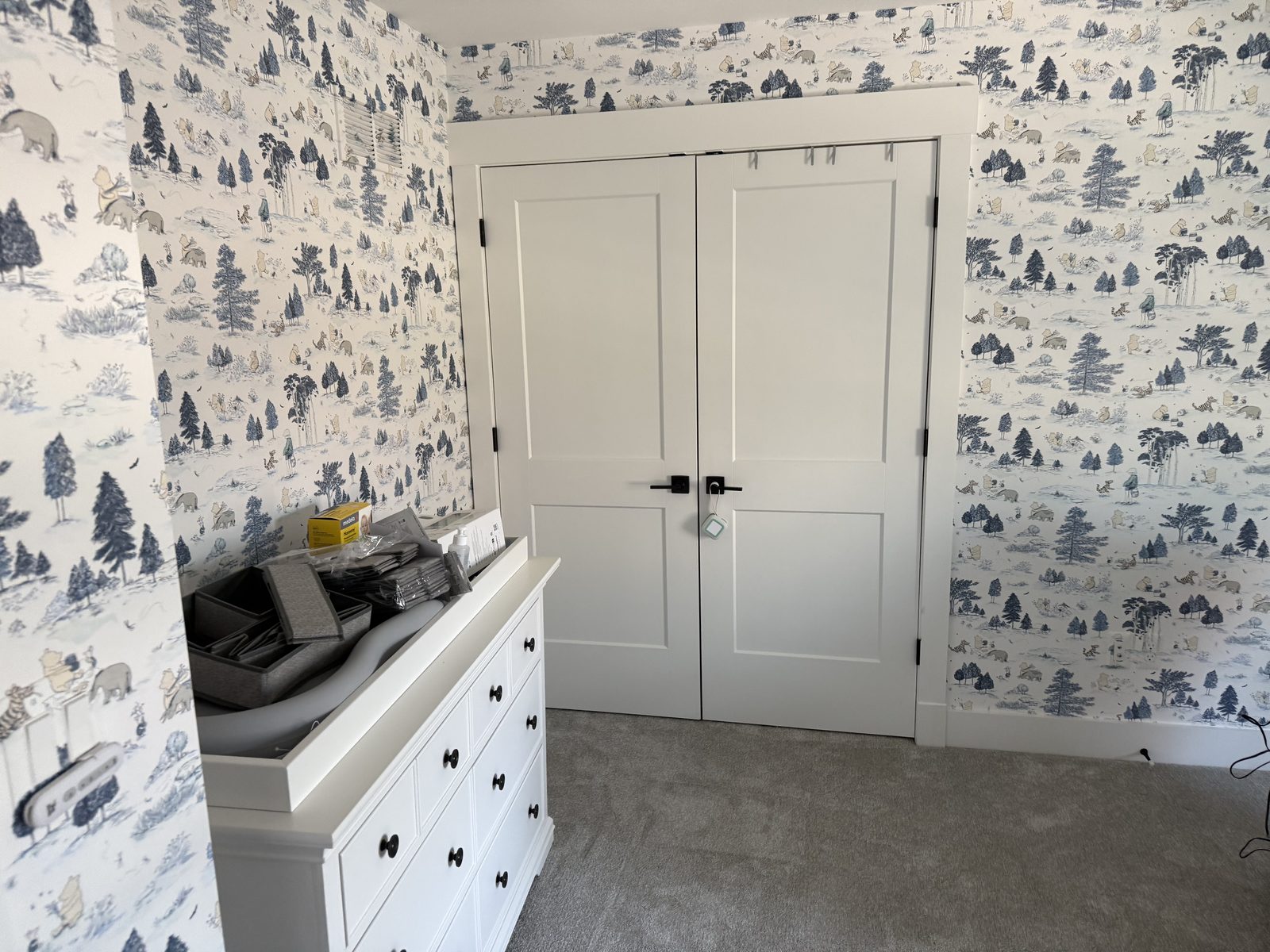
When I finished, the room hadn't quite become a nursery yet.
The crib mattress was still wrapped in plastic.
There were boxes on the dresser.
The glider still had its tag.
Everything was waiting.
But the room itself was ready.
Pooh was on the walls.
Tigger was somewhere among the trees.
Eeyore had found his place.
Christopher Robin was there too.
And what had begun as four ordinary walls in a house in Plymouth had become a little blue-and-cream landscape waiting for somebody very small to arrive and discover it.
Perhaps that is the nicest thing about putting Winnie the Pooh in a nursery.
The adults already know who he is.
The child gets to find out.
Barry Bernau is the owner of Bernau Designs, a professional wallcovering installation company specializing in wallpapered nurseries and focal walls in Plymouth, Northville, and communities throughout Wayne and Oakland counties.