
How to Strip Wallpaper the Easy Way
A professional wallpaper removal job in Grosse Pointe, Michigan
By Barry Bernau, professional wallpaper installer
Updated August 18, 2026
I’ve been installing and removing wallpaper professionally since 1990, mostly across metro Detroit. This article is how I actually strip wallpaper on a job — using photos and details from a paper wallcovering I recently removed in Grosse Pointe, Michigan.
I don’t use scoring tools or DIF, and most jobs don’t need a steamer either. What I use is very hot water, liquid laundry detergent, a pump sprayer, and enough patience to let the moisture do the work.
What Kind of Wallpaper Are You Removing?
Before you pull out any tools, test a small area at the bottom of the wall, at a seam near a corner. Grab the edge with your fingers and try peeling upward.
If it comes off cleanly in large sections, you’re in luck — you probably have a fabric-backed vinyl. The face will pull off in full sheets and all you’ll have left is the paste on the wall.
If it tears into small pieces, you probably have a paper-backed wallcovering. The Grosse Pointe job I’m walking through here was that kind of paper. It takes soaking, but it still comes off — if you give the moisture time to work.
What You’ll Need
- Pump-style garden sprayer
- Very hot water
- Liquid laundry detergent — Tide or similar (no bleach)
- Painter’s plastic and old drop cloths
- Painter’s tape
- Green Scotch-Brite scrubby
- 3-inch or 6-inch putty knife
- Clean microfiber rags
- Bucket of clean warm water
- A positive attitude

Prep the Room
Wallpaper stripping is wet work. Put painter’s plastic on the floor along the full length of the wall — water runs down and pools at the baseboard, so don’t skip this. Lay old drop cloths over the plastic to catch runoff.
Move furniture away from the walls.
Electrical outlets and switches need respect, not a wide berth. Leave the plates on, tape them with painter’s tape, and don’t mist directly around them. The bit of wallpaper close to any outlet or switch you can handle later by hand with a sponge — no need to spray it.
Mix the Solution
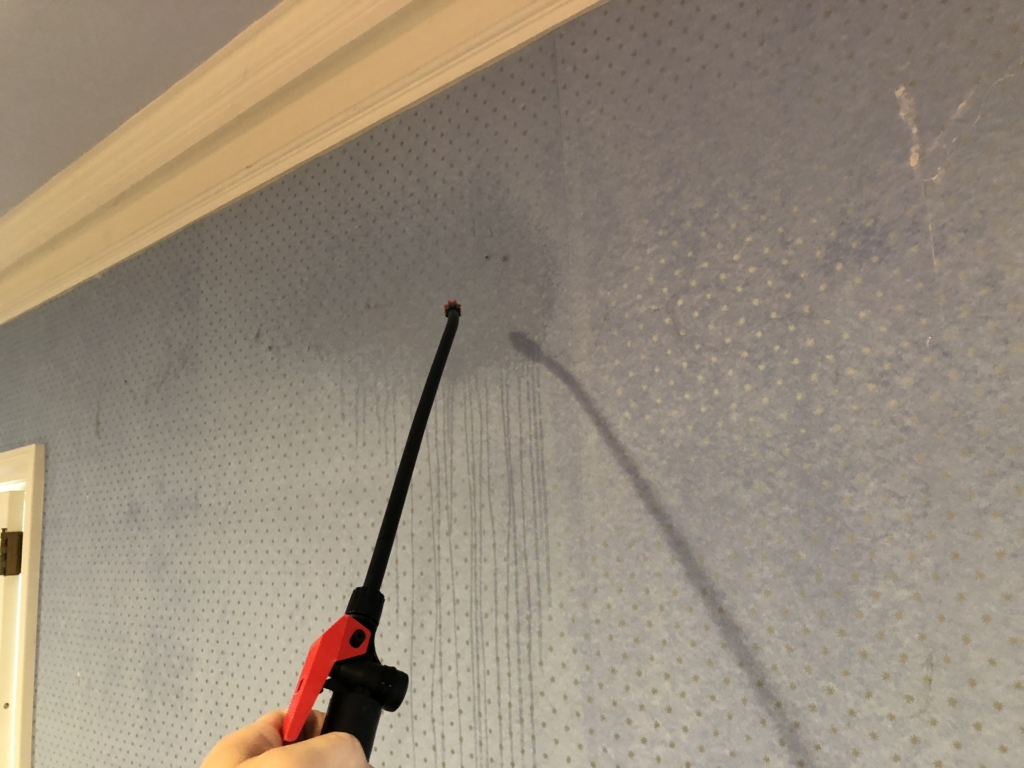
Fill your pump sprayer with very hot water and add about 1 to 1½ cups of liquid laundry detergent per gallon. Liquid Tide is what I reach for. No bleach. Pump the sprayer to pressurize it and give it a shake to mix.
Some people use fabric softener instead — I don’t. Liquid detergent works, and I’ve been using it on jobs for decades.
Spray and Let It Soak
I think of the detergent the same way you’d think of shaving lather. When you shave, the lather holds moisture against your beard so the hair has time to soften instead of the water evaporating off. On a wall, the detergent does the same job — it holds the hot water against the wallpaper face long enough for the paper to absorb it, and then for the paste underneath to reactivate.

Start at the top of a sheet and mist it evenly all the way down. Keep it wet. Work about three or four sheets ahead — by the time you’ve sprayed the fourth sheet, the first one is starting to release.
Give it up to 15 minutes to work. Some papers release faster. You’ll often see the paper start to bubble slightly as the paste behind it reactivates. That’s the sign it’s ready.
Don’t rush this part. This is where people usually get impatient and start trying to force the paper off. Let the moisture do the work.
Remove the Wallpaper
Once the solution has soaked in for its full time, the paper should pull right off the wall — that’s how the Grosse Pointe job went.

Start at the bottom of a soaked sheet, slide your putty knife gently under the edge, and work the wallpaper upward. Take off the biggest pieces you can.
If a section starts tearing into small pieces or feels like you’re fighting the wall, stop. Mist it again, give it another couple of minutes, and try again. Forcing dry wallpaper off a wall creates more work than it saves — and it can damage the drywall paper face underneath.
How to Remove Wallpaper Paste
This is the part people skip. Don’t.
Once the wallpaper is gone, there’s still paste on the wall. That has to come off before you paint or hang new paper. Here’s how:
- Re-mist the paste with your same hot detergent solution.
- Let it sit 3 to 4 minutes.
- Take a green Scotch-Brite scrubby and work in small circular swirls to loosen and reactivate the paste.
- Follow behind with a clean microfiber rag and fresh water. Wipe the wall completely clean.
Rinse your rag often and change the water in your bucket every few sheets. Once the bucket starts looking like paste soup, you’re not cleaning the wall anymore — you’re putting paste back on it.
What Happens If You Paint Over Wallpaper Paste?
The wall cracks. Not next month — as soon as the paint dries.
The water in the paint reactivates the paste left underneath. The paste starts to expand under the drying paint film. The paint dries first on top, and as the paste keeps swelling below it, the whole surface cracks in a spider-web pattern.
I’ve been on more than a few walls where somebody stripped the paper, thought they were done, painted the room, and had to strip it again a week later — plus scrape and prime the cracked paint. Getting the paste off takes an hour. Skipping it costs a day.
Let the Wall Dry, Patch, and Prime
After the wallpaper and paste are off, I let the wall dry for a full day. I believe in letting everything dry thoroughly before I start patching, priming, or hanging new wallpaper.
Once it’s dry, fill nail holes and small imperfections, sand smooth, wipe off the dust, and prime.
If you’re planning to hang new wallpaper next, prep is just as important as the installation itself. See my article on prepping and priming walls before wallpaper installation, and why use a wallpaper primer walks through which one to use.
This Grosse Pointe Wallpaper Removal Job
This particular Grosse Pointe job was a paper wallcovering. The method above — hot water, liquid Tide in the pump sprayer, patience with the soak time — released the paper cleanly. After the paste came off and the walls dried for a full day, some light patching to fill nail holes, a coat of primer, and then we re-papered the room.
That’s the complete professional workflow: strip → clean the paste → dry → patch → prime → new wallpaper. No steamer, no DIF, no shortcuts.
Do You Need to Score Wallpaper?
No.
A scoring tool wrecks the wall. The little teeth punch through the wallpaper and into the paper face of the drywall behind it, and now you’re repairing drywall on top of the removal job you were trying to speed up.
If the paper won’t release, I don’t reach for a scoring tool. I give it more time and more hot detergent water. If it’s still really stuck after that, that’s when I’ll bring out the steamer.
Do You Need a Wallpaper Steamer?
I own a Wagner wallpaper steamer and I use it when wallpaper is really, really difficult to get off the wall. It isn’t where I start. I start with hot water, liquid detergent, and enough time for the paper and paste to absorb the moisture. If that isn’t getting the job done, that’s when I’ll bring out the steamer.

I don’t start with a steamer, but I keep a Wagner on hand for the walls that really fight back.
Does DIF Wallpaper Remover Work?
No. In my opinion, it’s a waste of money.
I used DIF back in the 1980s. It was around six dollars a bottle even then, which was a lot of money, and I was never impressed with how it worked.
One day I was in a bind and didn’t have the money to buy another bottle, so I used liquid Tide with hot water instead.
To my surprise, it worked.
That was one of the best things that happened to me professionally, because I realized I didn’t need DIF at all. Hot water and liquid Tide did the job better for me, and I’ve been using that method ever since.
So no, I don’t recommend spending money on DIF. Use very hot water and liquid Tide.
Wallpaper Removal in Grosse Pointe and Metro Detroit
Bernau Designs handles wallpaper removal throughout Grosse Pointe, Troy, Birmingham, Bloomfield Hills, and the greater Detroit area. If you’d rather have someone who does this for a living take care of it, contact us for an estimate or call 248-924-8944.
Barry Bernau is the owner of Bernau Designs and has been installing and removing wallpaper professionally throughout metro Detroit since 1990.
